Journal / Creative Direction
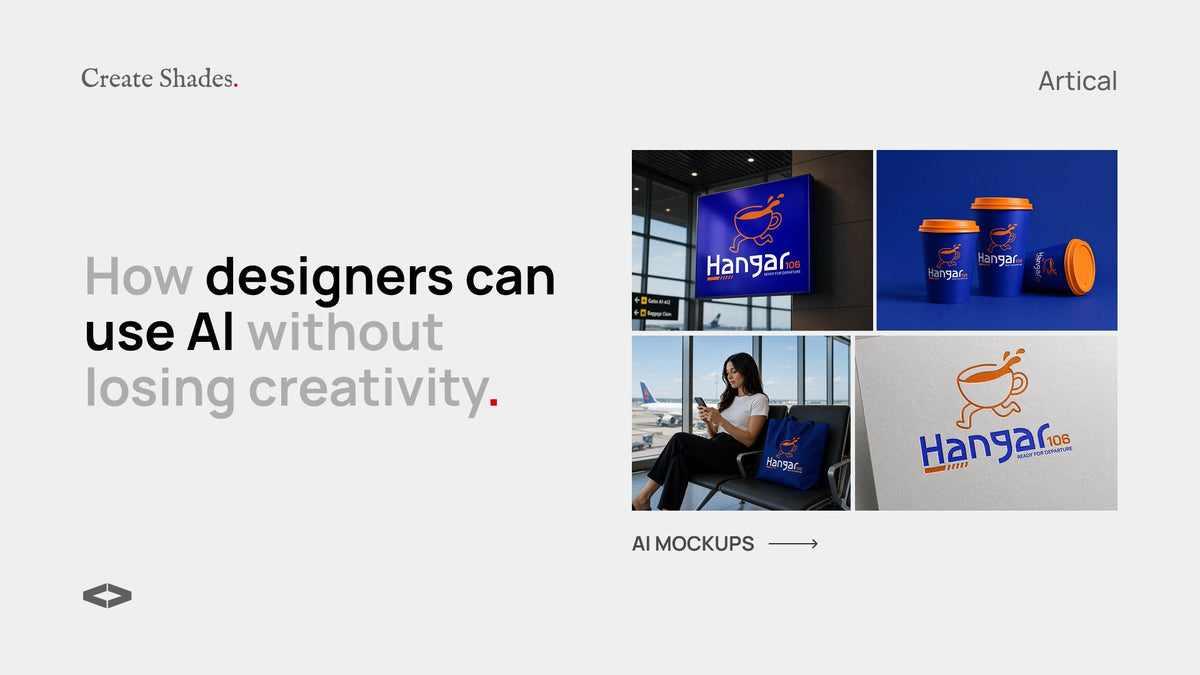
how designers can use ai without losing creativity.
AI Won't Replace Great Designers—But It Will Change How They Work
Ever since AI became mainstream, one question has dominated creative conversations:
"Will AI replace designers?"
It's a valid concern.
Every week, new AI tools emerge that can generate images, logos, layouts, copy, and even complete brand concepts within seconds. For many designers, this rapid evolution feels both exciting and intimidating.
As a designer, I've experimented with AI extensively—from generating creative concepts and mood boards to accelerating research and content creation. What I've learned is that AI isn't replacing creativity. It's changing where creativity happens.
The designers who thrive in the coming years won't be the ones competing against AI.
They'll be the ones learning how to collaborate with it.
In this article, we'll explore where AI can genuinely help designers, where human creativity remains irreplaceable, and how to build a workflow that combines the strengths of both.
Where AI Helps Designers
AI excels at speed.
It can process information, generate variations, and assist with repetitive tasks much faster than humans.
1. Research and Discovery
Before starting a branding project, designers often spend hours researching competitors, industries, visual trends, and customer expectations.
AI can accelerate this process by:
- Summarizing research
- Identifying trends
- Generating competitor insights
- Creating initial mood board directions
Instead of spending hours collecting information, designers can spend more time interpreting it.
2. Idea Generation
One of AI's strongest use cases is generating possibilities.
When starting a project, AI can help generate:
- Brand name ideas
- Visual directions
- Content concepts
- Marketing angles
- Creative prompts
This doesn't replace ideation.
It expands it.
Think of AI as a brainstorming partner rather than a creative director.
3. Content Creation
Many designers today are also content creators.
AI can help generate:
- Blog outlines
- Social media captions
- LinkedIn post drafts
- Newsletter ideas
- Course structures
The designer still shapes the final message, but AI removes the friction of starting from a blank page.
4. Repetitive Design Tasks
AI is particularly useful for:
- Background removal
- Image enhancement
- Object cleanup
- Asset generation
- Mockup creation
These tasks save time without reducing creative quality.
Practical takeaway:
Use AI to handle repetitive work so you can focus on strategy, storytelling, and design thinking.
Where Humans Still Win
While AI is impressive, it lacks something essential:
Human experience.
The best design isn't simply attractive.
It's meaningful.
And meaning comes from understanding people.
1. Strategic Thinking
AI can generate options.
Humans decide which option is right.
When creating a brand identity, designers consider:
- Business goals
- Audience psychology
- Market positioning
- Long-term growth
These decisions require context, judgment, and experience.
2. Emotional Intelligence
Design is ultimately about people.
Great branding creates emotional connections.
Humans understand:
- Empathy
- Culture
- Personal experiences
- Social context
- Storytelling
AI can mimic emotion.
Humans create it.
3. Original Ideas
AI generates based on existing data.
Humans create based on observation, curiosity, and imagination.
Many breakthrough ideas emerge from:
- Travel experiences
- Nature
- Personal stories
- Conversations
- Unexpected connections
These insights often cannot be replicated through algorithms alone.
4. Client Relationships
Clients don't hire designers solely for visuals.
They hire them for:
- Guidance
- Collaboration
- Problem-solving
- Communication
Trust remains a fundamentally human advantage.
Practical takeaway:
The future belongs to designers who combine creative thinking with AI efficiency.
My AI-Assisted Design Workflow
Rather than replacing my process, AI supports it.
Here's an example:
Step 1: Research
I use AI to explore industry trends, customer behavior, and competitive positioning.
Step 2: Inspiration
I generate mood board directions and creative prompts to expand possibilities.
Step 3: Concept Development
This stage remains largely human-led.
Strategy, storytelling, and design decisions happen here.
Step 4: Visual Creation
Tools help speed up production, generate references, and test ideas quickly.
Step 5: Refinement
The final direction is always refined through human judgment.
Because good design isn't about generating options.
It's about choosing the right one.
Ethics, Originality, and Responsible Use of AI
As AI becomes more powerful, designers have a responsibility to use it thoughtfully.
The goal should never be to copy.
The goal should be to create.
Ethical AI Use Includes:
- Using AI for inspiration, not imitation
- Avoiding direct replication of existing work
- Being transparent about AI-assisted processes
- Respecting intellectual property
- Prioritizing originality
AI should support creativity—not replace it.
The strongest designers use AI as a tool, not a shortcut.
A Simple Rule
If AI creates everything, you're no longer designing.
If AI helps you think better, you're using it correctly.
The Future of Design in the Age of AI
AI will continue to evolve.
Design tools will become faster.
Automation will become smarter.
But the demand for creativity won't disappear.
In fact, it may become even more valuable.
As AI makes execution easier, strategic thinking, storytelling, and originality will become stronger differentiators.
The designers who succeed won't be those who avoid AI.
They'll be the ones who learn how to direct it.
Much like photographers adapted to digital cameras and designers adapted to computers, creative professionals will adapt to AI.
And those who embrace change thoughtfully will unlock entirely new possibilities.
Final Thoughts
AI is not the end of creativity.
It's the beginning of a new creative era.
The most successful designers won't choose between AI and human creativity.
They'll combine both.
Use AI to research faster.
Use AI to generate ideas.
Use AI to remove repetitive tasks.
But keep your curiosity, perspective, and creative judgment at the center of the process.
Because tools evolve.
Creativity remains timeless.
Want to Learn My AI-Powered Creative Workflow?
I regularly share insights on branding, design, AI tools, and creative systems that help designers work smarter without sacrificing originality.
Explore my services, digital products, and upcoming courses to discover how AI and creativity can work together.
need help designing something that sells.
Brands, packaging, campaigns and illustration: let's talk about your project.